Does your business still need a mobile app in 2026? An honest answer
Mobile website or mobile app? A simple, honest way for small business owners to decide in 2026, with real numbers and a decision flow.

3 min read
"Do I need an app?" is the question I get most from small business owners. A shop owner in Dhaka, a coaching centre, a restaurant with a delivery side. They've seen big brands push their apps everywhere, and they wonder if they're falling behind.
My honest answer surprises some of them: most businesses should start with a good mobile website, not an app. But some businesses really do need an app, and for them, waiting too long costs real money.
Here's how I'd decide, in plain words.
Mobile is where your customers already are
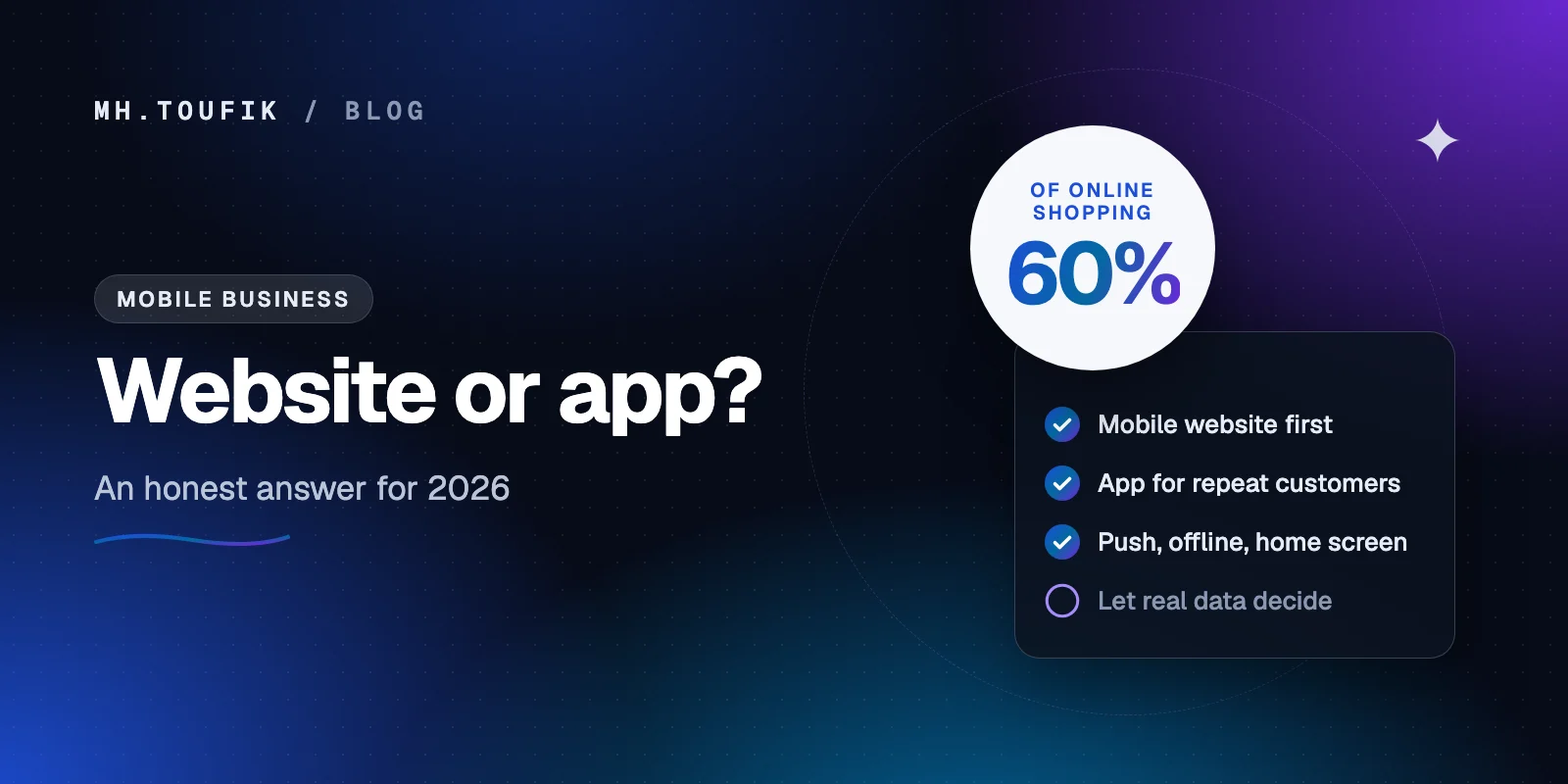
This part isn't up for debate any more. Around 60% of online shopping worldwide now happens on a phone, according to Statista figures quoted by several commerce reports. In Bangladesh, the latest BBS survey (April–June 2026) found that 75.1% of people use a smartphone and 59.2% use the internet, up from 55% a year earlier.
So the real question isn't "mobile or not?" It's "mobile website or mobile app?"
What a website does better
A mobile website is the right first step for most businesses because:
- People find it on Google. Nobody searches the Play Store for "best biryani near me". They search Google.
- There's nothing to install. One tap on a link and the customer is in.
- It's cheaper and faster to build. One comparison this year put a mobile-friendly site at roughly $1,000–$3,000, and a custom app at $15,000–$120,000+, plus about 15–20% a year to maintain it.
- One update reaches everyone. No waiting for store review, no users stuck on an old version.
If people buy from you once or twice a year, a fast website will do almost everything you need.
What only an app can do
An app starts to win when customers come back often:
- Push notifications. A website can't reliably tap someone on the shoulder; an app can. "Your order is on the way." "Class starts in 30 minutes."
- A spot on the home screen. Your logo sits next to Facebook and bKash. That's daily visibility no ad can buy.
- Offline use. When I built প্রশ্নব্যাংক, my SSC/HSC question bank app, offline was the whole point. Students revise on buses and in villages with patchy data. A website simply can't do that well.
- Phone features. Camera, GPS, alarms, Bluetooth, smooth payments. My HeyUtho alarm app couldn't exist as a website, because a website can't wake you up at 6:30.
- Higher conversion from loyal customers. App users tend to open more often and convert better than mobile-web visitors. Exact numbers vary a lot by source, so I won't quote one, but the direction is consistent.
A simple way to decide
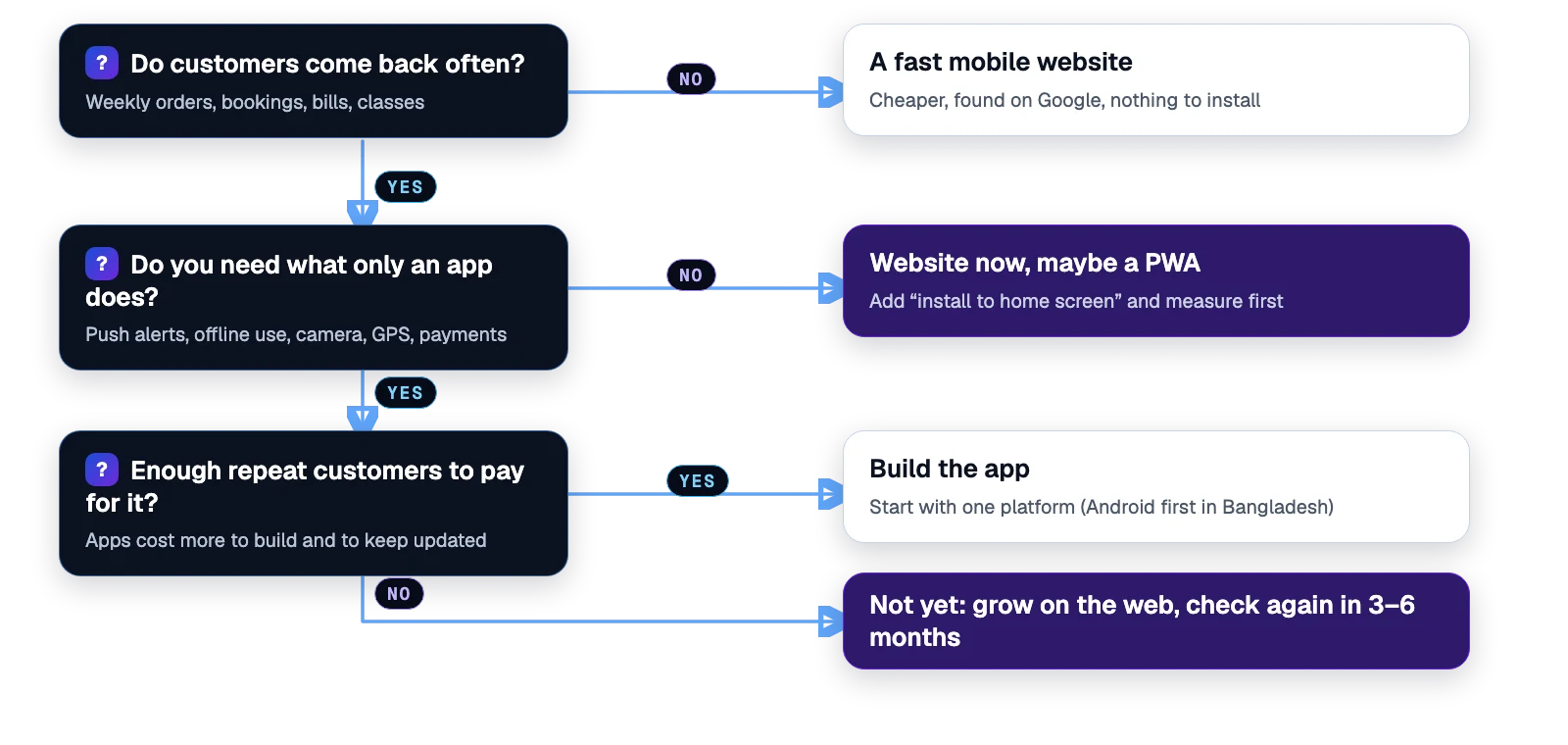
Ask yourself three questions:
- Do customers come back often? Weekly orders, monthly bills, daily classes. If not, a website is enough.
- Do you need something only an app does? Push alerts, offline mode, camera, GPS, in-app payments. If not, a good website (maybe installable as a PWA) covers you.
- Do you have enough repeat customers to pay for it? An app is not a one-time cost. Every Android and iOS release asks for updates.
If you answered yes three times, build the app.
If you do build, start small
A few things I'd tell any business owner before they spend money:
- Start with one platform. In Bangladesh, most of your customers are on Android. Launch there, learn, then decide on iOS.
- Build the one job customers repeat. Reordering, booking, checking a result. Not your whole website squeezed into an app.
- Plan for slow networks and small phones. Keep the app light, cache what you can, and make it usable offline where it makes sense.
- Budget for updates. Google Play now requires apps to target recent Android versions to publish updates. An app nobody maintains slowly stops being installable.
- Measure before you expand. Daily active users, repeat orders, notification opt-ins. Let data, not fear, decide the next step.
The bottom line
A mobile website gets you found. An app keeps you close to the customers who already love you.
If you're not sure which one you need, start with the website and watch your numbers. If people keep coming back, that's your sign it's time for an app. And if you'd like a second opinion on your idea, get in touch. I'm always happy to talk it through.
Keep reading
All postsBuilding an Android alarm that actually rings: what HeyUtho taught me
I helped a friend ship HeyUtho, a math-challenge alarm. The math was easy. Making Android ring on time, every time, wasn't. Here's what I learned.
5 min read
Compose Multiplatform for iOS is stable. Should you share your UI now?
Compose Multiplatform for iOS has been stable since May 2025. Here's when sharing UI between Android and iOS pays off, and when native SwiftUI still wins.
4 min read
On-device AI in mobile apps: Gemini Nano vs Apple's Foundation Models
Android and iOS both ship a language model on the phone now. What Gemini Nano and Apple's Foundation Models can do, where they fall short, and how to start.
4 min read
Comments
No comments yet — start the conversation.